⏱ 8 min read
Choosing the right growth engine is a foundational decision for any SaaS company. The debate between product-led growth (PLG) and sales-led growth (SLG) centers on whether your product’s inherent value or a dedicated sales force drives customer acquisition and expansion. This article provides a clear comparison of both methodologies, examining their core principles, ideal use cases, and implementation frameworks to help you determine the optimal strategy for your business model, target market, and funding stage.
Key Takeaways
- Product-led growth relies on the product itself as the primary driver of acquisition, conversion, and expansion.
- Sales-led growth depends on a human sales team to guide prospects through a structured buying process.
- The choice hinges on product complexity, customer persona, average contract value, and available capital.
- Many successful companies eventually blend elements of both into a hybrid growth model.
- Key metrics differ: PLG focuses on product usage and virality, while SLG tracks lead velocity and pipeline.
What is Product-Led Growth?
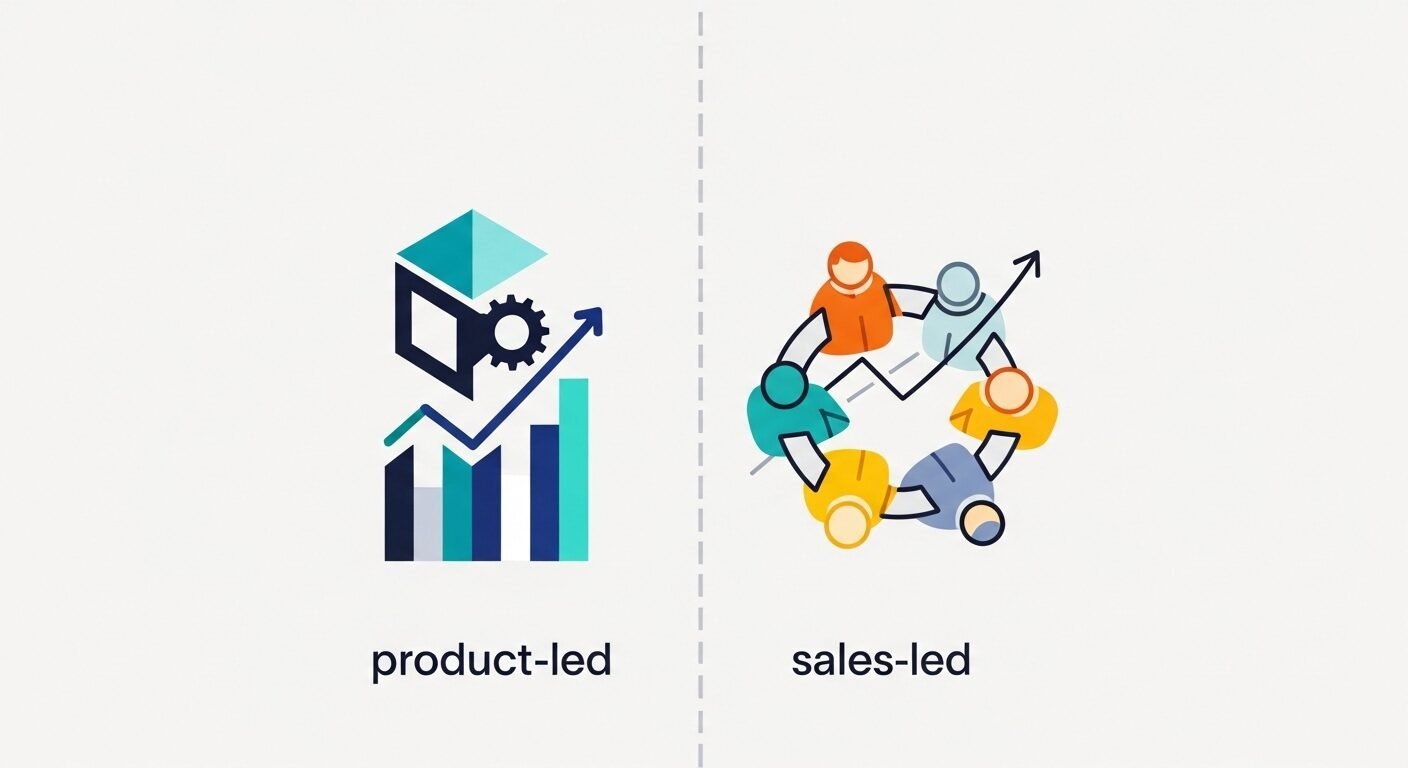
Product-led growth (PLG) is a go-to-market strategy where the product itself is the primary vehicle for acquiring, activating, and retaining customers. It prioritizes a self-service, low-friction user experience, often through freemium models or free trials, allowing the product’s value to be discovered organically.
Product-led growth places the product at the center of all customer-facing motions. The core idea is that a great product will market, sell, and expand itself. This model fundamentally shifts the power to the end-user, allowing them to experience value before any significant commitment. Companies like Slack, Dropbox, and Calendly pioneered this approach by making their tools easily accessible.
According to industry data, PLG companies often achieve higher valuation multiples due to efficient scaling. The user onboarding process is critical. It must be intuitive and quickly demonstrate the core ‘aha’ moment. Success metrics revolve around user engagement, activation rates, and viral coefficient. Experts recommend a PLG approach for products with a low barrier to entry and clear individual utility.
What is Sales-Led Growth?
A sales-led growth strategy relies on a dedicated sales team to drive revenue. This model involves human-led outreach, demos, negotiations, and closing deals. The sales process is a structured journey managed by professionals who guide high-consideration buyers. It is the traditional model for enterprise software and complex B2B solutions.
In a sales-driven model, marketing generates leads, but sales owns the conversion. The buying cycle is typically longer and involves multiple stakeholders. Pricing is often customized, and contracts are negotiated. This approach is common for products with high annual contract values (ACV) that require significant implementation or change management. Companies like Salesforce and Oracle built empires using this methodology.
The sales funnel is meticulously managed. Key performance indicators include lead conversion rates, average sales cycle length, and quota attainment. Research shows that for high-ticket items, personalized human interaction remains crucial for overcoming objections and building trust. The standard approach is to align marketing and sales teams closely through service level agreements.
Key Differences: A Direct Comparison
Understanding the distinction between these go-to-market strategies requires a side-by-side analysis. The table below outlines the fundamental contrasts across several business dimensions.
| Dimension | Product-Led Growth (PLG) | Sales-Led Growth (SLG) |
|---|---|---|
| Primary Driver | The product experience | The sales team |
| Initial User Access | Self-service, often free | Gated behind a sales conversation |
| Buying Cycle | Bottom-up, user-driven | Top-down, executive-driven |
| Ideal Customer Profile | Individuals & small teams | Medium to large enterprises |
| Average Contract Value | Lower to mid-range | Mid to very high |
| Key Metrics | Activation rate, virality, NPS | Lead velocity, win rate, CAC |
| Team Focus | Product & user experience | Sales & account management |
The product-led approach often leads to faster initial adoption but may require robust product analytics. The sales-led model typically involves higher customer acquisition costs but can secure larger, more stable contracts. Your product’s complexity and your target customer’s risk tolerance are major deciding factors.
How to Choose the Right Model for Your SaaS
Selecting the optimal growth strategy is not about trends; it’s about fit. You must evaluate your product, market, and resources. The decision matrix should balance your product’s inherent sellability with your target customer’s buying preferences. Start by asking foundational questions about your business.
Is your product easy to try and understand without guidance? If yes, PLG is a strong candidate. Does your solution require significant configuration, integration, or organizational buy-in? If yes, SLG is likely necessary. Consider your average selling price. Products under $5,000 per year often lean PLG, while those over $50,000 are almost always sales-assisted.
Analyze your customer’s journey. Do they prefer to research and purchase independently, or do they expect white-glove service? Also, assess your funding. PLG can be capital efficient but may require significant upfront product investment. SLG requires capital to build and scale a sales team before seeing returns. Experts in the field recommend mapping your decision to these core variables.
A Step-by-Step Framework for Evaluation
- Assess Product Complexity: Can a user achieve value in under 15 minutes without help? Simple, intuitive products favor PLG.
- Define Your Buyer: Is your user also the budget holder (bottom-up), or is the decision made by a separate executive (top-down)?
- Calculate Target Contract Value: Determine your ideal Annual Contract Value (ACV). Lower ACV supports self-service; higher ACV requires sales justification.
- Audit Your Resources: Do you have capital to hire and manage a sales team, or should you invest in perfecting the product experience first?
- Analyze the Competitive Landscape: How do your closest competitors go to market? There may be a proven model in your niche.
Implementing Your Chosen Strategy
Execution separates a good strategy from great results. For a product-led motion, your entire company must obsess over the user experience. Instrument your product to track key behavioral metrics that predict conversion and retention. Build seamless paths from free to paid plans. Your pricing page becomes a critical sales asset.
For a sales-led motion, you need a repeatable playbook. This includes defining your ideal customer profile, building a lead generation engine, and creating sales enablement materials. Training your team on handling objections and navigating multi-threaded deals is essential. According to SaaS Growth Online, alignment between marketing-qualified leads and sales acceptance criteria is a common success lever.
Regardless of the path, measurement is non-negotiable. PLG teams monitor daily active users, feature adoption, and expansion revenue. SLG teams track pipeline generation, sales cycle length, and customer lifetime value. The standard approach is to establish clear north star metrics for your chosen model within the first quarter of implementation.
The Rise of Hybrid Models
The line between product-led and sales-led is increasingly blurred. Most modern SaaS companies adopt a hybrid approach. They use the product to attract and engage users, then deploy sales to close and expand high-potential accounts. This combines the scalability of PLG with the high-touch control of SLG.
A common hybrid model is a product-led sales motion. Users sign up freely, but sales teams identify and engage accounts showing strong product usage signals. This is often called ‘product-qualified leads’. Another variant is a sales-assisted free trial, where demos are offered to accelerate evaluation for interested teams. This approach can significantly increase conversion rates for mid-market deals.
Research shows that hybrid models can optimize customer acquisition cost and maximize enterprise deal size. The key is integrating systems so product usage data informs sales outreach, and sales insights feed back into product development. This creates a powerful, customer-centric growth loop.
Frequently Asked Questions
Can a startup begin with a product-led growth strategy?
Yes, many startups begin with PLG as it allows for rapid market validation and user feedback with lower initial sales overhead. A self-service model can efficiently scale early adoption before investing in a sales team for larger accounts.
What is the typical sales cycle length for each model?
Product-led cycles can be minutes or days for individual plans. Sales-led cycles often range from 30 to 90 days for mid-market and 6+ months for enterprise. The complexity of the decision-making unit directly impacts duration.
How do you measure success in a product-led company?
Three core metrics are activation rate (users reaching the ‘aha’ moment), expansion revenue (upsells from usage), and viral coefficient (how many new users each user brings in). High net revenue retention is the ultimate goal.
Is one model more profitable than the other?
Profitability depends on execution, not the model itself. PLG can achieve superior margins at scale due to automation. SLG can secure higher-value contracts that justify the sales cost. Efficient CAC payback is critical for both.
Can you switch from one model to another?
Transitioning is possible but challenging. It often requires changes to product, pricing, team structure, and culture. Most companies evolve by adding elements of
1 thought on “Product-Led Growth vs. Sales-Led Growth: Which Strategy is Right for Your SaaS?”